

What do samba bands play? Part 1: Candomble arrangements

This is the third year of the Worldwise Samba Drummer blog. The first year’s posts provided a general understanding of samba drumming whilst the second year’s posts described the different instruments used in a samba band like Worldwise Samba Drummers. This year’s posts will go through some of the pieces that we play and have played in the past in order to describe some different styles of drumming. Whereas some bands specialise in a particular style - batucada, samba reggae or maracatu, for example - Worldwise Samba Drummers play different styles, adapting them as necessary for the instruments that we use. In this first post of the year, we will look at candomble pieces.
Candomble comprises the singing, drumming, dancing, costumes and rituals of people removed from West Africa to Brazil as part of the slave trade as they sought to preserve and adapt their spiritual practices. People from different regions and religions were mixed together and influenced by the Roman Catholicism of the Portuguese occupiers of Brazil leading to the development of candomble.
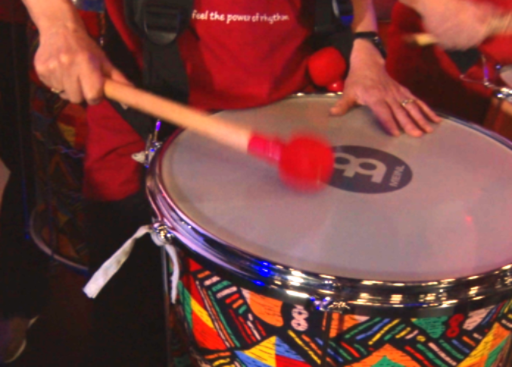
The various candomble pieces refer to different orixas, the candomble deities. Candomble pieces were originally played on bells, shakers and atabaques - similar in shape and sound to conga drums. These pieces can be arranged to fit the drums of the samba bateria and several of these pieces were taught to us by candomble initiate Jon Hardeman.
There are four pieces Worldwise Samba Drummers have played that refer to specific orixas, these being Oxossi, Ogun, Oya and Xango.
Oxossi is a hunter and a provider. When Worldwise Samba Drummers used to perform alongside the Preston Samba Dancers, the dancers could be seen loading up their (imaginary) bows and arrows, selecting a target and firing. In the music, there are musical ‘stabs’ as the arrows are released.

Ogun (also known as Ogum) is a restless warrior, always ready for change, transformation, evolution. He is sometimes depicted with a machete-like knife that he uses to clear the path ahead. The music we play for Ogun contrasts stability with stasis. Over unchanging rhythms from the surdos 1 & 2 and the timba, we move through five different patterns for the surdo 3 section as well as three tamborim patterns and two caixa patterns.
Oya is a fearless fighter, connected to wind and fire, to love and death. When Worldwise Samba Drummers play the Oya piece, we change our side-to-side samba step to a sweeping L-shaped step that signifies a brushing away of the old and unwanted to make way for the new.
Xango is an axe-wielding conqueror associated with thunder. The Xango piece is amongst our fastest and most energetic. The patterns played by the surdos - the largest of the bateria instruments - become increasingly dense and thunderous. When we perform this piece, a repinique part is added towards the end, high pitched and furiously fast, to indicate lightening.
Please check out the other blog posts and get in contact using the Contact Us or Join Us links if you would like further information about the Worldwise Samba Drummers.



Comments